
Local SEO vs. Social Media: What Drives More Leads for Small Businesses?
Compare local SEO and social media using 2026 data. Learn where to focus your marketing budget for better leads.
WebWise Management
5/13/20266 min read

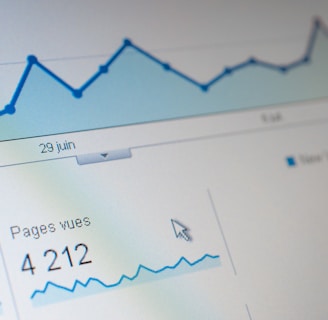
Local SEO vs. Social Media: Where Should Small Businesses Focus in 2026?
Introduction: The Dilemma of Limited Marketing Budgets
Small-business owners rarely have unlimited time, money or staff. Every marketing decision has an opportunity cost. If you spend more time posting on Instagram, does that mean your Google Business Profile gets neglected? If you invest in SEO, are you missing conversations happening on Facebook, TikTok or LinkedIn?
That is the real challenge behind the local SEO vs social media debate. Both channels matter, but they do different jobs.
Local SEO helps customers find you when they are actively searching for a nearby product or service. Social media helps customers discover, remember and engage with your brand before or after they need you. One captures demand. The other often creates and nurtures it.
For most small businesses in 2026, the smartest answer is not “choose one.” It is to prioritise based on intent, budget and capacity.
What Is Local SEO?
Local SEO is the process of making your business easier to find in local search results. For most small businesses, it includes two core assets: your website and your Google Business Profile.
Your website gives you a permanent home for your services, products, locations, reviews, case studies, blog posts and contact details. Your Google Business Profile helps you appear on Google Search and Google Maps, including in the Google Map Pack: the map-based local results that often appear above standard organic listings.
Google says local results are mainly based on relevance, distance and prominence. It also recommends keeping your Business Profile complete and accurate, updating hours, responding to reviews and adding photos and videos. More reviews and positive ratings can help local ranking, while complete business information helps Google understand what you offer.
In practical terms, local SEO helps you appear for searches such as “emergency plumber near me,” “accountant in [town],” “best café open now,” or “website designer for small business.”
The strength of local SEO is intent. People searching locally are usually closer to taking action.
What Is Social Media Marketing?
Social media marketing uses platforms such as Facebook, Instagram, TikTok, LinkedIn and YouTube to build awareness, engage audiences, share updates, answer questions and promote products or services.
Its biggest strength is attention. DataReportal’s April 2026 update estimates 5.79 billion social media user identities worldwide, equivalent to 69.9% of the global population. The same report says social media consumption averages 18 hours and 36 minutes per week when social networks and video-centric platforms are included.
That means your customers are almost certainly using social platforms. But being present on social media does not automatically mean generating leads. Social media is often better at creating familiarity, demonstrating personality, showing behind-the-scenes activity and encouraging repeat engagement.
It is especially useful for visual businesses, hospitality, wellness, retail, events, personal brands and community-based services.
Traffic and Lead Generation Statistics
The numbers show why local SEO deserves serious attention.
A widely cited Google event statistic says 46% of Google searches have local intent, although this figure is older and should be treated as a useful benchmark rather than a new 2026 measurement. More recent BrightLocal data shows that 80% of US consumers search online for local businesses weekly, while 32% search daily. BrightLocal also reports that 45% of consumers default to Google for local searches and 15% default to Google Maps.
Google’s own mobile research found that 76% of people who search on their smartphone for something nearby visit a related business within a day, and 28% of those searches result in a purchase. This is the key advantage of local SEO: it reaches people when they are already looking.
There is also strong evidence that websites and SEO outperform social media as primary lead sources for small businesses. Clutch’s 2025 small-business website report found that 40% of small businesses with a website cite SEO as their top source of leads, while only 10% of small businesses cite social media as their top lead source.
Social media still has commercial value, but it often performs differently. HubSpot cites research showing that 79% of customers expect a response to social media posts within 24 hours. Sprout Social reports that 63% of consumers agree their loyalty to a brand is significantly influenced by the quality of customer support provided on social media. Older social customer-care research also found that 71% of consumers who have a positive brand experience on social media are likely to recommend the brand to friends and family.
The comparison is clear: local SEO is often stronger for high-intent lead capture, while social media is powerful for engagement, trust, customer service and referral momentum.
Costs and Resource Requirements
Local SEO and social media require different types of investment.
Local SEO usually needs upfront strategic work: website optimisation, service pages, location pages, Google Business Profile setup, review strategy, technical SEO and content planning. It may take longer to show results, but the work can keep generating visibility over time.
Social media often requires constant output. Posts, reels, stories, comments, inbox messages and community engagement all demand regular attention. A quiet social profile may look abandoned, while a busy one can become a customer-service channel that needs fast responses.
Local SEO Pros
Local SEO attracts people who are already searching for your service. It supports Google Map Pack visibility, builds long-term discoverability and can turn your website into a lead-generation asset. It is also easier to connect to measurable actions such as phone calls, form fills, direction requests and bookings.
Local SEO Cons
It takes time to build authority. Competitive industries may need ongoing content, reviews, backlinks and technical improvements. Results are not instant, and neglected listings can lose accuracy over time.
Social Media Pros
Social media is excellent for brand personality, visual storytelling, customer interaction and community building. It can support launches, promotions, events, testimonials and customer service. It is also useful for staying visible between purchase moments.
Social Media Cons
Organic reach can be unpredictable. Content has a short shelf life, and regular posting can become time-consuming. Social media followers may not always have buying intent, so engagement does not automatically equal enquiries.


Long-Term ROI Comparison
For many local businesses, SEO produces stronger long-term return because it compounds. A well-optimised service page, helpful blog post or complete Google Business Profile can continue attracting visitors long after it is published.
Social media is more immediate but often less durable. A post may perform well for a few days, but it usually fades quickly unless boosted, shared or repurposed. That does not make social media less valuable; it means the ROI model is different.
Think of local SEO as your digital foundation. Think of social media as your relationship engine.
A local dental clinic, for example, may generate high-intent enquiries from searches such as “emergency dentist near me” or “teeth whitening [city].” But social media can help that clinic show friendly staff, patient education, community involvement and reviews. The SEO brings people in at the moment of need; social media makes the business feel familiar and trustworthy.
An e-commerce retailer with a local store may use social media to showcase products and trends, while local SEO captures “near me,” “open now,” and product-specific search demand.
The best ROI usually comes when the two channels support each other.
Creating a Balanced Marketing Mix
A practical digital marketing budget allocation depends on your business model.
If you are a service business that relies on urgent or location-based searches, such as plumbing, legal services, accounting, healthcare, trades or home services, local SEO should usually be the first priority. Customers are actively searching, and visibility in Google Search and Maps can drive direct enquiries.
If you are a visual or lifestyle business, such as a café, salon, boutique, gym, venue or wellness brand, social media may deserve a larger share of daily effort. But your website and Google Business Profile still need to be accurate, complete and optimised.
A balanced approach might look like this:
Foundation: Website, Google Business Profile, reviews and local SEO.
Visibility: Blog content, service pages, local landing pages and GBP updates.
Engagement: Social posts, short videos, stories, community interaction and customer care.
Conversion: Clear calls to action, enquiry forms, booking links, click-to-call buttons and tracked campaigns.
For many small businesses, a sensible starting point is to make local SEO the lead-generation foundation, then use social media to support awareness, trust and repeat engagement.
Conclusion
So, where should small businesses focus in 2026?
If your goal is direct enquiries from people actively looking for your services, local SEO should usually come first. Your website and Google Business Profile help you appear when customers have intent, location and urgency on their side.
If your goal is awareness, loyalty, community and brand personality, social media is essential. It keeps your business visible, human and responsive.
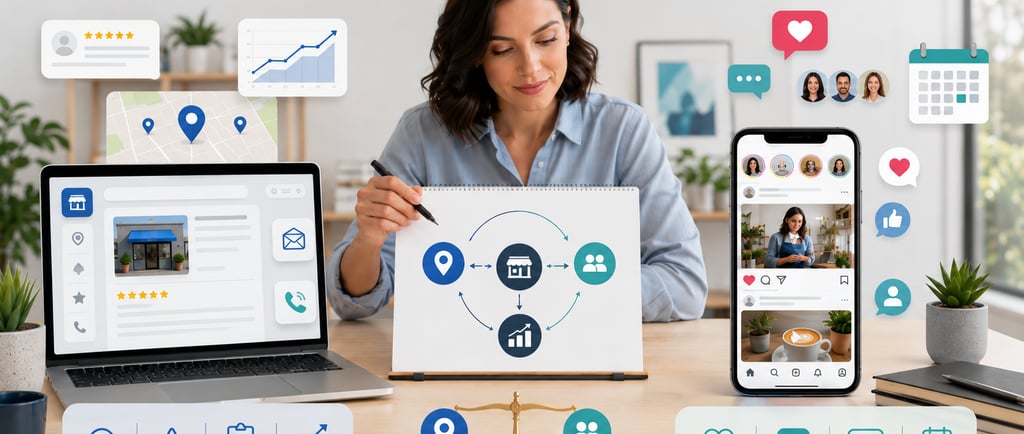
The real answer is not map pack vs social media marketing. It is using each channel for what it does best. Local SEO captures demand. Social media builds connection. Together, they create a stronger, more resilient marketing system.
Need help deciding where your marketing budget will work hardest? Contact WebWise Management for an integrated local SEO and social media strategy that helps your business get found, build trust and generate more leads in 2026.
Contact
Reach out anytime for personalized support.
Email:
Phone:
+27 72 709 7557
© 2026. All rights reserved.