
Local Landing Pages: How to Target Areas Without Spammy SEO
Learn how to create useful local landing pages for different towns, suburbs and service areas without copying content or hurting trust.
WebWise Management
6/8/20268 min read
Local Landing Pages Done Right: How to Target Different Areas Without Sounding Spammy
What Is a Local Landing Page?
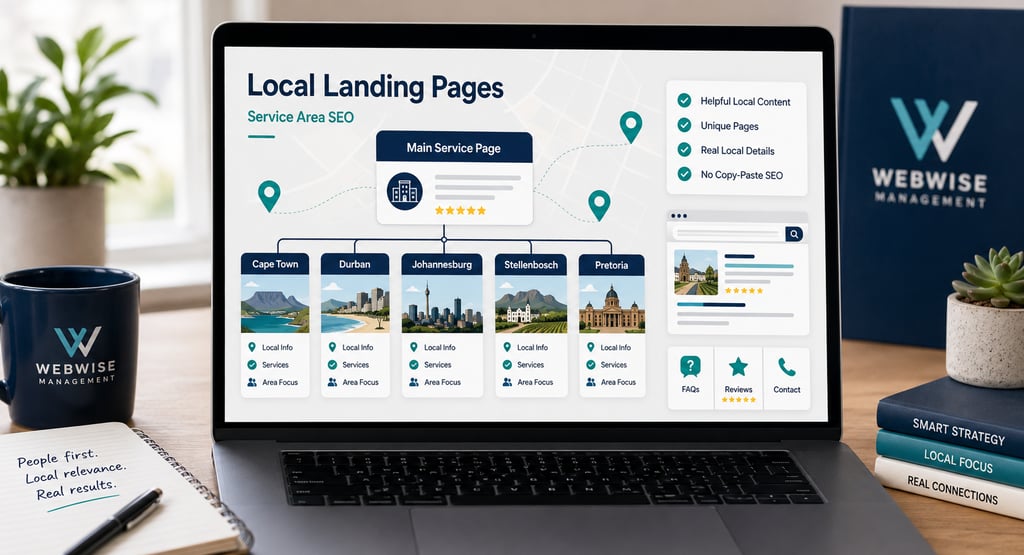
A local landing page is a website page created for a specific town, suburb, city or service area your business serves. Instead of having one general service page that says “we work everywhere,” a local landing page helps customers in a specific area understand whether you can help them.
For example, a plumbing company might have pages for:
Emergency plumber in Sandton
Geyser repairs in Randburg
Leak detection in Fourways
A travel company might have pages for:
Honeymoon travel agent in Cape Town
Family holiday planning in Durban
Corporate travel services in Johannesburg
A consultant might have pages for nearby regions they serve in person or online.
The goal is not to trick Google by copying the same page dozens of times with only the location name changed. The goal is to create useful, location-specific pages that help real people decide whether your business is relevant to them.
That distinction matters. Google’s guidance says people-first content is created primarily for people, not to manipulate search engine rankings. It also encourages content that gives visitors a satisfying experience and genuinely answers their needs.
When Does Your Business Need Location Pages?
Not every business needs local landing pages. If you serve only one small area and already have a clear local homepage, you may not need multiple pages.
Location pages are useful when:
You serve several towns, suburbs or regions.
Customers search for your service plus a specific area.
You have different services, teams or availability by location.
You have proof of work in different areas.
You want to rank for local searches beyond your main address.
You operate as a service-area business without a shopfront.
You have multiple branches or offices.
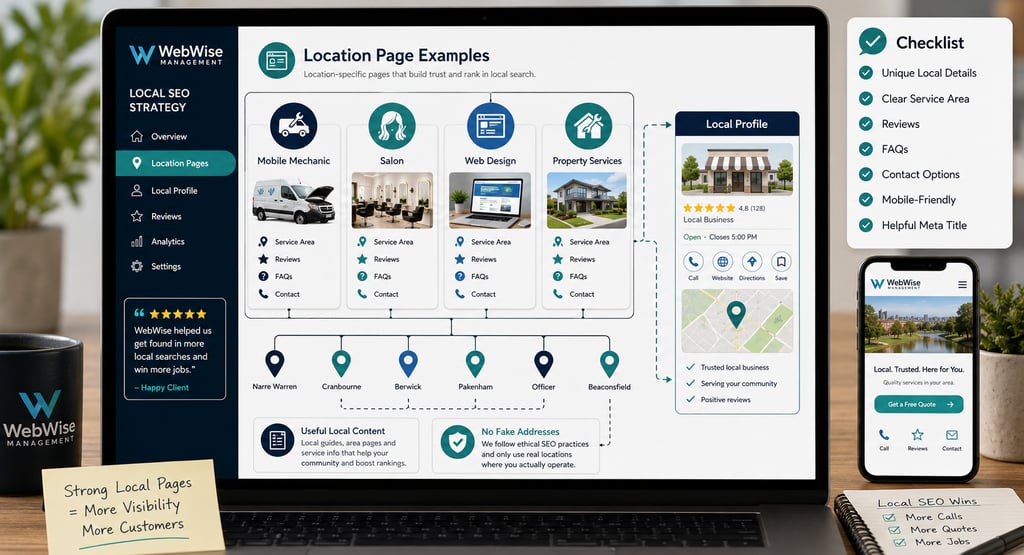
For example, a mobile mechanic serving five nearby towns may benefit from separate location pages if each page includes useful local details, common service needs, testimonials, travel information and clear contact options.
However, if you create 50 near-identical pages such as “Plumber in Area A,” “Plumber in Area B,” and “Plumber in Area C,” with the same copied paragraphs, customers will notice. It looks spammy, and it can damage trust.
Good service area SEO is about relevance, not repetition.
What Google Wants from Helpful Local Content
Google’s local ranking guidance says local results are mainly based on relevance, distance and prominence. Relevance is how well a Business Profile matches what someone is searching for. Distance considers how far the business is from the searcher or searched location. Prominence reflects how well-known the business appears to be. Google also says complete and accurate business information helps customers know what a business does, where it is and when they can visit.
This applies directly to location page SEO.
Your location pages should help both customers and search engines understand:
What service you offer.
Which area the page is about.
Whether you genuinely serve that area.
Why customers in that area should choose you.
How they can contact, book or request a quote.
What proof you have that you work there.
The page should feel like it was written for people in that location, not produced from a template with a suburb name inserted.
Google’s helpful content guidance supports this approach. Content should be useful, reliable and created for people first. SEO is valuable when it helps people find useful information, but it should not replace the goal of creating genuinely helpful content.
How to Avoid Duplicate, Spammy Pages
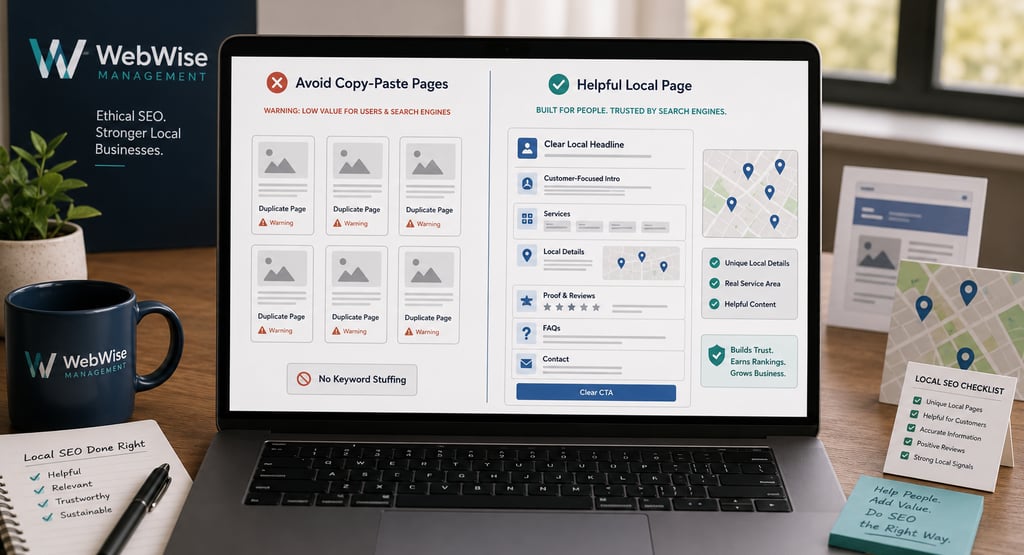
The biggest mistake businesses make with website pages for different locations is copying and pasting.
A spammy location page usually looks like this:
“Looking for the best plumber in [Location]? We are the leading plumber in [Location]. Our plumber in [Location] offers plumbing services in [Location]. Contact us today for plumbing in [Location].”
That kind of copy is not helpful. It sounds unnatural and does not build confidence.
To avoid spammy local pages:
Do not swap only the location name.
Each page should include unique details about the area, customers, services or projects.
Do not overuse the keyword.
Use the location naturally in the title, introduction, headings and contact section, but avoid repeating it awkwardly.
Do not create pages for areas you do not serve.
If you cannot realistically help customers there, do not target the location.
Do not publish thin pages.
A 200-word page with no useful information is unlikely to persuade customers.
Do not pretend to have an office where you do not.
Be transparent. If you are a service-area business, say you serve the area rather than claiming a physical branch.
Ethical local SEO builds trust. Spammy local SEO creates doubt.
What to Include on Each Location Page
A strong local landing page should be specific, useful and conversion-focused. Use this structure.
1. A Clear Local Headline
Your headline should make the service and location obvious.
Examples:
“Geyser Repairs in Randburg”
“Website Design for Small Businesses in Durban”
“Mobile Tyre Fitment Services in Pretoria East”
“Property Maintenance Services in Stellenbosch”
This helps customers instantly know they are on the right page.
2. A Customer-Focused Introduction
Start with the customer’s problem. Avoid opening with generic company history.
Example:
“Need reliable property maintenance in Stellenbosch? Whether you manage a rental property, holiday home or small commercial space, our team helps keep repairs, inspections and maintenance tasks under control.”
This speaks to the visitor’s needs while naturally including the location.
3. Services Offered in That Area
List the services available in that location. Be specific.
For a home services company:
Emergency repairs
Routine maintenance
Installations
Inspections
Preventative checks
Quotes and assessments
For a web agency:
Website design
Website maintenance
Blog writing
Local SEO
Google Business Profile optimization
Service page copywriting
If services vary by area, say so clearly.
4. Local Details That Prove Relevance
This is where you separate a useful page from a copied one.
Include details such as:
Nearby suburbs served.
Common problems in the area.
Local property types.
Local customer needs.
Travel or callout information.
Parking or access notes, if relevant.
Seasonal issues affecting that area.
Local regulations or practical considerations, where appropriate.
For example, a roofing company might mention that homes in a coastal area often need corrosion-resistant materials. A travel agent might mention popular departure airports or local customer preferences. A property service company might mention common maintenance issues in older neighbourhoods.
The key is to add real context.
5. Proof and Trust Signals
Customers want to know you are credible. Add proof that supports the location page.
This might include:
Testimonials from customers in that area.
Photos of completed work nearby.
Case studies.
Review snippets.
Before-and-after examples.
Industry certifications.
Years of experience.
Team or vehicle photos.
A testimonial from the relevant location is especially useful:
“WebWise helped us improve our service pages and local SEO. We started receiving more enquiries from customers in our target areas.”
Even one genuine local example can make the page feel more trustworthy.
6. FAQs for That Location
FAQs help answer common questions and support search relevance.
Examples:
Do you serve all of Randburg?
Yes, we assist customers across Randburg and nearby areas, depending on availability and service type.
Do you charge a callout fee for this area?
Callout fees depend on the service required and exact location. Contact us for a clear quote before work begins.
Can you help with urgent bookings?
Where possible, we offer urgent assistance. Availability depends on current schedules and the nature of the request.
For SEO and trust, FAQs should be real questions customers ask, not keyword-stuffed filler.
7. Clear Contact Options
Every location page should make it easy to enquire.
Include:
Phone number.
WhatsApp link, if used.
Contact form.
Booking link.
Quote request button.
Service area confirmation.
Business hours.
A visitor should never need to hunt for the next step.
8. A Strong Call-to-Action
End the page with a clear CTA.
Examples:
“Request a quote for plumbing services in Randburg.”
“Book a website consultation for your Durban business.”
“Contact our team for property maintenance in Stellenbosch.”
“Ask WebWise Management to create SEO-friendly location pages for your service area.”
The CTA should match the service and the customer’s stage of decision-making.
Examples of Good Location-Specific Content
Here are a few examples of how to make local landing pages feel useful rather than spammy.
Example 1: Mobile Mechanic
Instead of copying the same text for every suburb, create a page that explains the most common vehicle issues in that area, whether you provide home or workplace visits, what nearby areas you serve and what customers should prepare before the mechanic arrives.
Include photos of your service vehicle, customer reviews and a simple booking process.
Example 2: Salon
A salon targeting nearby areas could create pages around bridal hair, colour appointments or treatments for customers in specific suburbs. The page might mention travel routes, parking, appointment timing and popular services among customers from that area.
Include before-and-after photos and testimonials.
Example 3: Web Design Company
A web design business could create location pages for small businesses in different cities. Each page should explain local business challenges, common industries served, services offered and examples of website improvements relevant to that market.
For example, a page for local service providers in Durban might discuss mobile enquiries, Google Business Profile visibility and service page clarity.
Example 4: Property Services
A property maintenance company could create area pages based on property type and local conditions. One town may have more holiday homes, another may have older residential properties, and another may have commercial units.
Each page should reflect those differences.
Linking Location Pages to Your Google Business Profile Strategy
Your website and Google Business Profile should support each other.
Google says complete and accurate Business Profile information helps customers understand what you do, where you are and when they can visit, and that complete profiles are more likely to appear in relevant local search results.
If you have one verified Google Business Profile for your main business, make sure it links to the most relevant page. For a single-location business, that may be the homepage. For a multi-location business, each branch profile should link to the relevant location page where appropriate.
For service-area businesses, your profile should accurately reflect the areas you serve. Your website location pages can then provide deeper detail about each important area.
Keep your NAP information — name, address and phone number — consistent where applicable. If you do not have a physical office in a town, do not pretend that you do. Say clearly that you serve customers in that area.
Local Landing Page Checklist
Use this checklist before publishing any location page:
Clear service plus location headline.
Unique introduction written for that area.
Specific services available in that location.
Natural location keywords.
Nearby suburbs or service areas.
Local customer problems or needs.
Proof of work, reviews or testimonials.
Relevant photos where available.
FAQ section with real customer questions.
Clear contact details.
Strong call-to-action.
Internal links to related services.
Link back to main service pages.
No copied-and-pasted paragraphs from other location pages.
No fake office address or misleading claims.
Mobile-friendly layout.
Fast-loading images.
Helpful meta title and meta description.
If a page does not help a customer in that location make a decision, improve it before publishing.
Final Thoughts
Local landing pages can be powerful for service businesses, but only when they are done properly. The goal is not to create dozens of near-identical pages for search engines. The goal is to create useful pages that help customers in specific areas understand your services, trust your business and take action.
Good local SEO for service businesses is built on relevance, clarity and honesty. Each location page should include unique local details, clear service information, proof, FAQs and contact options.
When done right, local landing pages can help your website target different towns, suburbs and service areas without sounding spammy or damaging trust.
Need help creating location pages that are useful, ethical and SEO-friendly? Contact WebWise Management for local landing page copywriting, website content and service area SEO support that helps your business reach more of the right local customers.
Contact
Reach out anytime for personalized support.
Email:
Phone:
+27 72 709 7557
© 2026. All rights reserved.