
How Google Reviews and Star Ratings Affect Local Customers
Reviews are often your first impression online. Learn how star ratings, review responses and recent feedback influence local customers.
WebWise Management
6/5/20267 min read
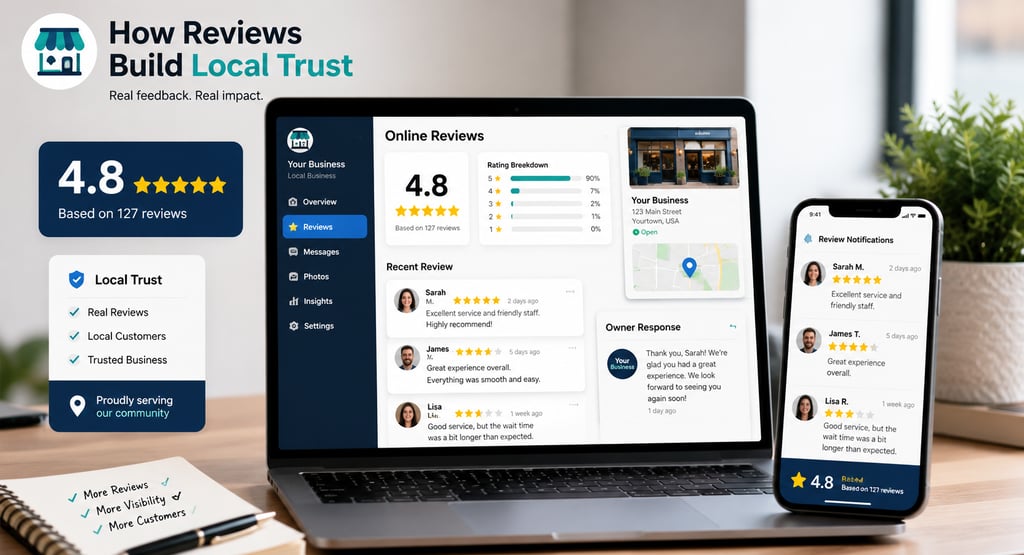
Reviews Are the New First Impression: How Star Ratings Affect Local Customers
Why Reviews Are Often Your First Impression
Before a customer visits your website, phones your business or walks through your door, they may already have formed an opinion about you.
That opinion often starts with reviews.
For local businesses, Google reviews are not just feedback. They are part of your public reputation. A customer searching for a plumber, salon, mechanic, restaurant, clinic, home service provider or consultant may compare businesses in seconds by looking at star ratings, review count, review recency and owner responses.
BrightLocal’s 2026 Local Consumer Review Survey found that 97% of consumers read reviews online when browsing for businesses, with 41% saying they “always” read reviews. That means reviews are no longer something customers check occasionally. For many people, they are a normal part of choosing who to trust.
Google also says reviews appear next to Business Profiles in Maps and Search, and can help a business stand out while giving potential customers helpful information.
That is why online reviews for local business matter so much. They influence trust before your sales pitch, website copy or phone manner has a chance to do its job.
Star Ratings and Customer Expectations
Star ratings create an instant impression. Even if a customer reads the written reviews later, the star rating is often the first signal they notice.
BrightLocal’s 2026 research found that 92% of consumers care about star ratings when choosing a business. It also found that 31% will only use a business with 4.5 stars or more, while 68% will only use a business with four stars or more.
That does not mean every business needs a perfect 5.0 rating. In fact, a few less-than-perfect reviews can make a profile look more natural. What matters is the overall impression: are most customers happy, are complaints handled well, and does the business seem reliable?
For a local customer, a star rating helps answer questions quickly:
Is this business trusted?
Do other customers recommend it?
Is there a pattern of good service?
Does this business look safer than the competitor beside it?
For industries where trust is essential — health, beauty, home services, automotive, hospitality, property and professional consulting — the rating can be especially influential. Customers may be inviting you into their home, trusting you with their vehicle, booking a personal treatment or making a decision that affects their money or wellbeing.
Your star rating is not just a number. It is a confidence signal.
Why Recent Reviews Matter
A strong rating is helpful, but recent reviews are just as important. Customers want to know what your business is like now, not only what it was like two years ago.
BrightLocal’s 2026 survey found that 74% of consumers only care about reviews written in the last three months, and 32% look specifically for reviews written within the last two weeks. It also found that 44% of consumers consider whether a review was posted within the last month when judging review trust factors.
This matters because businesses change. Staff change. Services change. Management changes. A salon may hire new stylists. A restaurant may update its menu. A contractor may improve scheduling. A clinic may add new treatments. Customers want feedback that reflects the current experience.
This is why a Google reviews strategy should be ongoing. Asking for ten reviews once and then ignoring reviews for a year is not enough. A steady flow of genuine reviews shows that your business is active and still delivering a good experience.
Review recency also helps balance occasional negative feedback. If you receive one poor review but continue earning positive, recent reviews, customers can see a broader and more current picture.
What to Do About Negative Reviews
Every business eventually receives criticism. The goal is not to avoid every negative review. The goal is to handle feedback professionally and learn from it.
Start by asking whether the complaint is valid. If the review points to a real issue, use it as customer experience data. Repeated complaints about delays, communication, cleanliness, booking problems or unclear pricing should not be ignored.
Next, respond publicly but briefly. Do not share private information, especially in health, wellness, legal, financial or personal service industries. Keep the response respectful and invite the customer to continue the conversation privately.
If a review is fake, abusive, irrelevant or violates Google’s policies, you can flag it. Google’s prohibited and restricted content policy says reviews should reflect a genuine experience and prohibits fake engagement, paid reviews, biased reviews, review manipulation and reviews created to undermine competitors.
However, do not flag a review just because it is negative. Genuine criticism is allowed. Trying to remove every negative review can make a business look less transparent.
A few professional responses to negative reviews can actually strengthen your reputation. They show that your business listens, cares and takes responsibility.
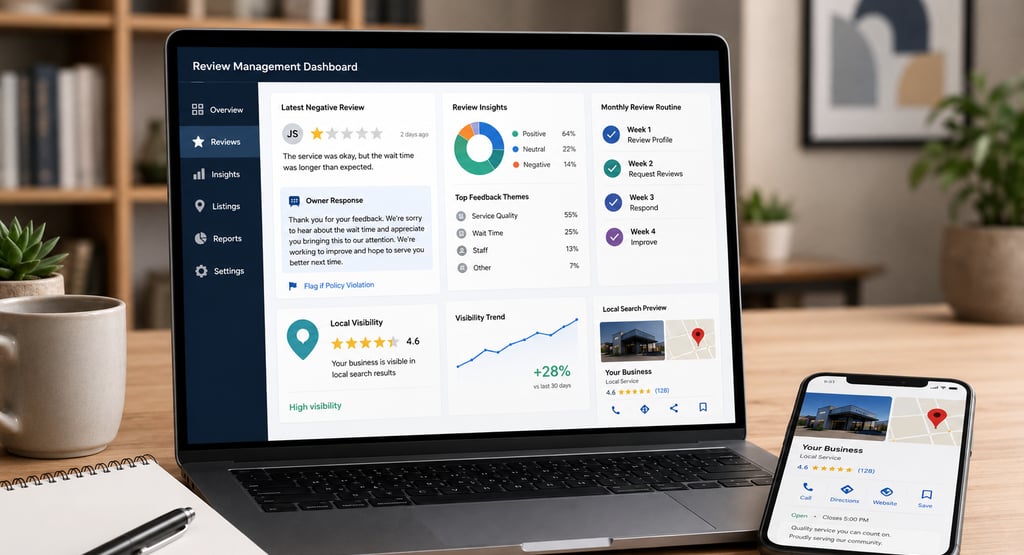
Building a Monthly Review Routine
Review management works best when it becomes a habit. A monthly routine helps you avoid long gaps, unanswered feedback and missed opportunities.
Here is a simple review management routine for local businesses:
Week 1: Review Your Current Profile
Check your Google rating, review count, most recent reviews and unanswered reviews. Look for patterns. Are customers praising the same strengths? Are complaints repeating?
Week 2: Request Reviews from Recent Customers
Choose customers who had genuine experiences with your business. Send a polite message with your review link or QR code. Do not offer incentives or request a specific rating.
Week 3: Respond to Every New Review
Reply to positive, neutral and negative reviews. Keep responses personal and professional. Avoid generic copy-and-paste replies.
Week 4: Turn Feedback into Improvements
Use review themes to improve your business. If customers praise fast communication, highlight that on your website. If they complain about unclear booking steps, fix the process. If they mention a specific service often, promote it more clearly.
This routine supports reputation management for small business because it connects reviews to real customer experience, not just marketing.
How Reviews Support Local SEO
Reviews also connect to local visibility. Google says local results are based mainly on relevance, distance and prominence. It also notes that more reviews and positive ratings can improve local ranking.
This means reviews can influence both trust and discoverability. A business with a complete Google Business Profile, strong review profile, current information and regular responses is better positioned than one with outdated details and no engagement.
For local businesses, star ratings and local SEO should not be treated separately. Reviews help people choose you, and they also help search engines understand your business’s prominence and credibility.
Final Thoughts
Reviews are the new first impression because customers often judge your business before they ever visit your website or speak to your team. Star ratings, recent reviews and owner responses all shape whether someone feels confident enough to contact you.
The good news is that review management does not require tricks. It requires consistency, professionalism and genuine customer care.
Ask for honest reviews. Respond to every review. Learn from feedback. Keep your Google Business Profile active. Build trust one customer experience at a time.
Need help creating a stronger review and reputation strategy? Contact WebWise Management for Google Business Profile and reputation management services that help your business earn trust, respond professionally and turn local searchers into customers.
How to Ask for Reviews Professionally
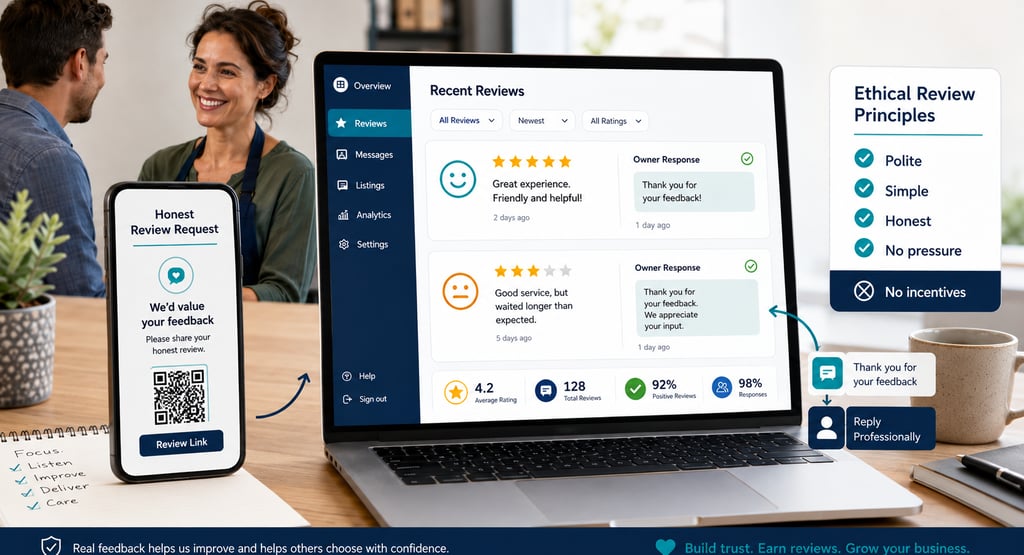
Many happy customers are willing to leave reviews, but they need a simple reminder. The key is to ask ethically and make the process easy.
Google says businesses can remind customers to leave reviews and can ask them to use a Google review link or scan a QR code. However, reviews must reflect a genuine experience, and offering incentives such as discounts, free goods or services in exchange for reviews, changed reviews or removed negative reviews is strictly prohibited.
A good review request should be:
Polite.
Simple.
Timely.
Honest.
Non-pressuring.
For example:
“Thank you for choosing us. If you were happy with your experience, we’d really appreciate an honest Google review. Reviews help other local customers choose with confidence.”
For a service business, the best time to ask is shortly after the job is completed and the customer has expressed satisfaction. For hospitality and beauty businesses, you might ask after a positive visit. For consultants, ask after a project milestone or successful outcome.
Avoid asking only for “five-star reviews.” Ask for honest feedback. This builds a more authentic review profile and keeps your business aligned with Google’s policies.
How to Respond to Reviews
A strong review response strategy is just as important as collecting reviews.
BrightLocal’s 2026 data shows that consumers pay close attention to business responses. It found that 80% of consumers are likely to use a business that responds to all reviews, while 42% are unlikely to use a business that never replies. It also found that 89% of consumers expect business owners to respond to reviews, and 81% expect a response within a week.
Responding shows customers that you listen. It also gives future customers a preview of your customer service.
Responding to Positive Reviews
Do not reply with the exact same “Thanks” message every time. A short, personal response is better.
Example:
“Thank you, Sarah. We’re so pleased you had a great experience with our team. We appreciate you choosing us and taking the time to share your feedback.”
This response is warm, specific and professional.
Responding to Negative Reviews
Negative reviews are uncomfortable, but they are also an opportunity to show accountability.
Google advises businesses to keep replies professional, polite, relevant and conversational rather than promotional. Google also says negative reviews can provide an opportunity to understand customer expectations and improve future experiences.
A good negative review response should:
Acknowledge the feedback.
Stay calm.
Avoid arguing.
Apologise where appropriate.
Offer a path to resolution.
Move sensitive details offline.
Example:
“Thank you for your feedback. We’re sorry your experience did not meet expectations. We’d like to understand what happened and see how we can help. Please contact us directly so we can look into this properly.”
Future customers are watching how you respond. A thoughtful reply can reduce the damage of a negative review and sometimes even increase trust.
Contact
Reach out anytime for personalized support.
Email:
Phone:
+27 72 709 7557
© 2026. All rights reserved.