
Handling Bad Reviews: Turn Negative Feedback into Growth Opportunities
Learn how to respond to negative reviews, protect your brand and turn complaints into customer loyalty.
WebWise Management
7/5/20268 min read
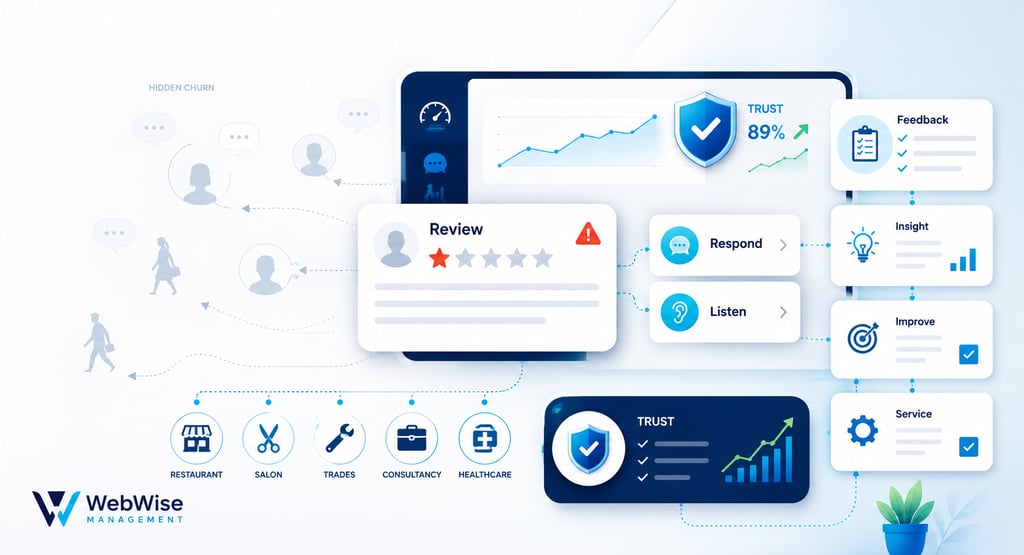

Turning Bad Reviews into Opportunities: How to Manage Negative Feedback and Protect Your Brand
Negative reviews can feel personal, especially when you run a local business. Whether you manage a restaurant, salon, trade service, consultancy or healthcare practice, a one-star review can land like a punch to the stomach. You know how hard your team works. You know the care that goes into each customer interaction. So when someone leaves a public complaint, the first instinct is often to defend, explain or ignore it.
But a negative review is not just criticism. It is a customer raising their hand and saying, “Something went wrong.” Handled well, that moment can become a powerful opportunity to show professionalism, empathy and accountability.
For local businesses, reputation is not a side issue. It is one of the main reasons people choose you over a competitor. BrightLocal’s 2026 Local Consumer Review Survey found that 89% of consumers expect business owners to respond to reviews, while 42% are unlikely to use a business that ignores reviews entirely. It also found that generic, templated replies make 50% of consumers less likely to choose a business.
That means your negative review response is not only for the unhappy customer. It is also for every future customer reading silently in the background.
The cost of ignoring complaints
Ignoring complaints can feel easier in the moment, but it is rarely cost-free. A negative review left unanswered can create the impression that your business is careless, defensive or unavailable when something goes wrong.
Zendesk’s customer service statistics roundup highlights just how quickly poor service can affect loyalty. It notes that more than half of consumers will switch to a competitor after only one bad experience, 73% will switch after multiple bad experiences, and three in four consumers will spend more with businesses that provide a good customer experience. The same roundup also cites that 56% of consumers rarely complain about a negative experience and instead quietly switch to a competitor, and that 79% would switch to a different company if it offered a better customer experience.
For a local business, this matters because a complaint is rarely an isolated incident. One review about slow service, poor communication or a missed appointment may point to a wider issue that other customers have experienced but never mentioned.
Imagine a plumbing company receiving a review that says:
“They arrived two hours late, didn’t call, and left a mess behind.”
It would be easy to dismiss this as one impatient customer. But it could reveal three operational problems: scheduling, communication and clean-up standards. If the business ignores the review, it loses the customer and the insight. If it responds well, investigates and improves, it protects both reputation and future revenue.
Only 1 in 26 customers complain: the hidden churn risk
One of the most important ideas in handling bad reviews is that the loudest complaints are not always the biggest problem. Silence can be more dangerous.
A widely cited customer experience statistic says only one in 26 unhappy customers will complain, while the rest simply leave. Customer Experience Magazine attributes this insight to Esteban Kolsky’s customer experience research and warns businesses not to mistake the absence of complaints for satisfaction.
Related customer service roundups also cite that 67% of customers mention bad experiences as a reason for churn.
In other words, a negative review may represent far more than one unhappy person. It may be the visible tip of a hidden churn problem.
For example:
A salon receives a review saying the stylist rushed the consultation and the final colour was not what the client requested. Even if only one person posts publicly, others may have felt the same but chosen not to return.
A restaurant receives a complaint about rude service on a busy Saturday night. The review may reveal a staffing or training issue during peak periods.
A consultant receives feedback that communication was unclear after onboarding. That may indicate a gap in expectation-setting, not just one difficult client.
The lesson is simple: when someone takes the time to complain, treat it as free business intelligence. It may be uncomfortable, but it gives you a chance to fix what silent customers will not tell you.
How to respond to negative reviews and comments
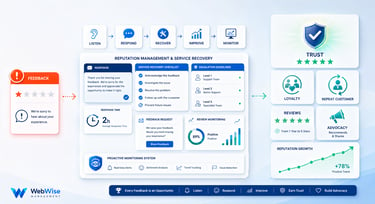
A good negative review response should do five things: acknowledge, apologise, clarify, move the conversation forward and show future readers that your business takes feedback seriously.
Google’s Business Profile guidance says customer reviews provide helpful feedback and that replying shows customers you value their input. Google also recommends keeping replies professional, polite, clear, helpful, short and honest.
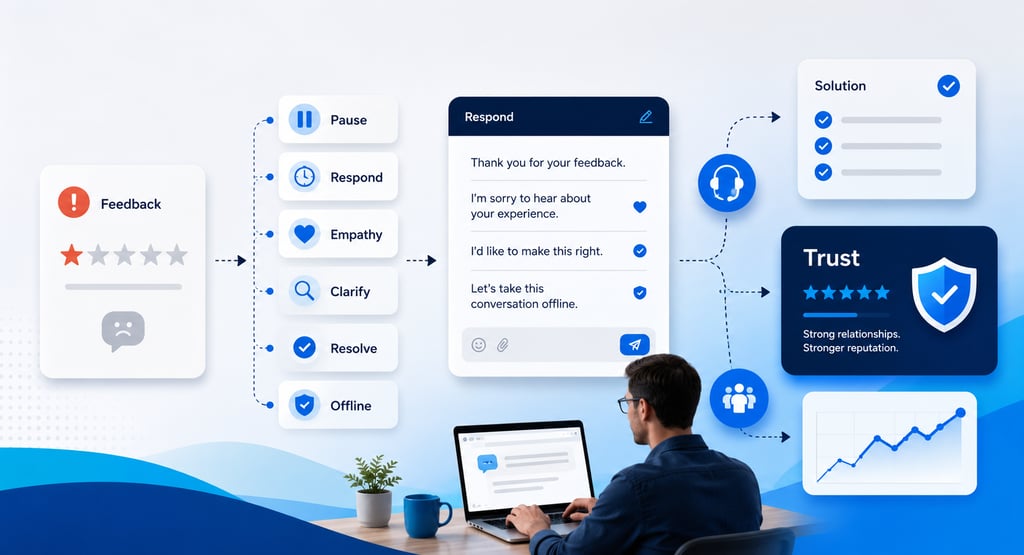
Here is a simple framework WebWise recommends:
1. Pause before replying
Do not respond while angry, embarrassed or defensive. Take a breath. Read the review twice. Separate the emotion from the facts.
Ask:
What is the customer upset about?
Did we make a mistake?
Is there missing context?
What would a future customer want to see from us here?
2. Respond promptly
Speed matters. BrightLocal found that 19% of consumers expect a same-day review response, and 81% expect a response within a week.
You do not need to solve everything in the public reply, but you should acknowledge the issue quickly.
3. Start with empathy
Avoid opening with a correction. Start with the customer’s experience.
Example:
“We’re sorry to hear that your visit didn’t meet expectations. We understand how frustrating it is to wait longer than expected, especially when you had made a booking.”
This does not admit legal fault. It shows you are listening.
4. Take responsibility where appropriate
If the business made a mistake, say so plainly.
Example:
“We should have communicated the delay sooner, and we apologise for that.”
Customers can usually tell when a business is hiding behind vague language. Honest accountability builds trust.
5. Move details offline
Public replies should not become debates. Invite the customer to contact you directly so you can understand the situation and resolve it.
Example:
“Please contact our manager at [email/contact] so we can look into this properly and make it right.”
For healthcare providers and other privacy-sensitive businesses, keep responses especially careful. Do not confirm personal details, appointment information, treatment history or whether the reviewer is a patient. A safer response is:
“Thank you for your feedback. We take concerns seriously and would welcome the opportunity to discuss this directly. Please contact our practice manager so we can assist you privately.”
6. Avoid copy-and-paste responses
Templates can help, but the final reply must feel human. BrightLocal found that generic responses make half of consumers less likely to choose a business.
Use the reviewer’s specific concern, but avoid repeating sensitive details.
When and how to offer compensation or solutions
Compensation can be useful, but it must be handled carefully. The goal is customer service recovery, not buying silence.
Offer a solution when:
the customer received less than they reasonably expected;
your team made a clear mistake;
the issue caused inconvenience, cost or embarrassment;
a repeat visit could genuinely create a better outcome.
Solutions do not always need to be financial. They may include:
redoing the service;
replacing a product;
refunding part or all of the purchase;
offering a priority appointment;
sending a manager to inspect the issue;
giving a clear explanation and process improvement.
For example, a restaurant might reply:
“We’re sorry your meal arrived cold. That is not the standard we aim for. We’d appreciate the chance to speak with you and arrange a replacement meal or another suitable solution.”
A trades business might say:
“We apologise for the lack of communication around the delay. We are reviewing our scheduling process and would like to discuss how we can put this right.”
Be careful not to offer compensation in exchange for changing or deleting a truthful review. The FTC warns that paying customers to change or remove truthful negative reviews may be considered unfair or deceptive if it distorts what consumers think about the business. It also prohibits incentives that require, or imply a requirement for, a positive review.
A good rule is: fix the problem because it is the right thing to do, not because you want the review removed.
Turning critics into brand advocates
Not every unhappy customer can be won back. Some people will not respond. Some complaints may be unfair. Some reviews may even be fake or malicious.
But many critics are simply disappointed customers who expected better. When you respond with care, they may become more loyal than customers who never had a problem at all.
This happens because recovery creates trust. A customer learns that if something goes wrong, your business will not disappear. You will listen, respond and act.
Here is what that can look like:
A salon client posts that her haircut felt rushed and uneven. The owner replies calmly, apologises and invites her back for a complimentary correction with a senior stylist. The client returns, receives a better experience and updates the review to say the business handled the situation professionally.
A restaurant guest complains about slow service during a birthday dinner. The manager calls, apologises, explains there was a staffing issue without making excuses, and offers to host the family again. The customer feels heard and later recommends the restaurant for how well it handled the problem.
A consultant receives a public complaint about unclear deliverables. Instead of arguing, they clarify the process privately, update their onboarding checklist and create a clearer scope document for future clients. The original client may or may not return, but the business improves.
This is the opportunity hidden inside a bad review: it can become proof that your brand cares.
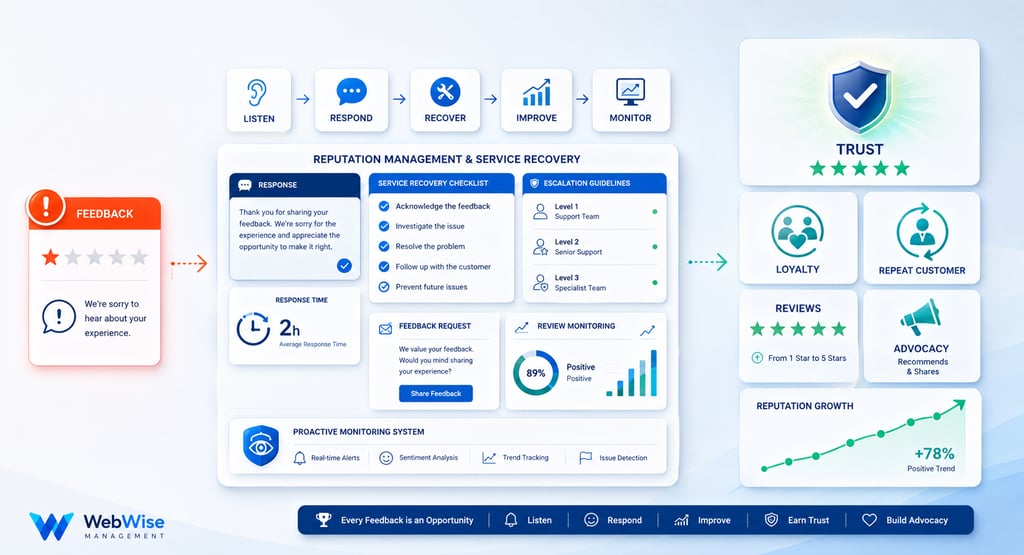
Building a proactive feedback and monitoring system
The best review strategy is not only reactive. It is proactive.
A strong reputation management system helps you spot issues early, respond consistently and build a steady stream of authentic positive reviews.
Start with these steps:
Monitor the right platforms
Track the platforms your customers actually use, such as Google Business Profile, Facebook, TripAdvisor, industry directories, booking platforms and niche review sites. For trades, this may include local directories. For healthcare, it may include healthcare-specific platforms. For restaurants and salons, Google and social platforms are often essential.
Assign responsibility
Do not leave reviews to whoever happens to notice them. Assign one trained person, or an external reputation management partner, to monitor, draft and escalate responses.
Set response time standards
Aim to acknowledge negative reviews within 24 to 48 hours where possible. Complex issues can be investigated after the initial response.
Create response guidelines
Your team should know what to say, what not to say and when to escalate. This is especially important for sensitive complaints, legal threats, staff accusations, safety concerns and privacy-related industries.
Ask for feedback before it becomes public
Send post-visit or post-service feedback requests. Ask simple questions such as:
“How was your experience?”
“Is there anything we could have done better?”
“Would you recommend us?”
This gives unhappy customers a direct channel and helps you solve problems before they become public reviews.
Encourage honest reviews ethically
Ask happy customers to share their experience, but never pressure them to leave only positive feedback. The FTC’s consumer review rule targets deceptive review practices, including fake reviews, reviews conditioned on sentiment and unfair review suppression.
Authenticity protects your reputation far more than inflated ratings ever will.
Protect your brand by showing how you handle pressure
A bad review does not have to define your business. What defines your brand is how you respond.
When you reply calmly, apologise where appropriate, offer practical solutions and use feedback to improve, you show customers that your business is trustworthy even when things do not go perfectly. For local businesses, that trust can be the difference between a lost customer and a loyal advocate.
Negative feedback is not just a reputation risk. It is a service improvement tool, a customer retention opportunity and a public demonstration of your values.
WebWise Management helps local businesses monitor reviews, craft professional responses, identify recurring customer issues and build stronger online reputations. Whether you need support with a single difficult review or a complete review-management system, our team can help you respond with confidence and protect the brand you have worked hard to build.
Need help handling bad reviews before they cost you customers? Contact WebWise Management to discuss our reputation management and review-response services.
Contact
Reach out anytime for personalized support.
Email:
Phone:
+27 72 709 7557
© 2026. All rights reserved.