
Email Segmentation & Personalization: The Secret to Small-Business Marketing Success
Discover how segmenting and personalizing emails can boost opens, clicks and conversions for small-business marketing.
WebWise Management
6/28/20267 min read
Email Marketing Success: How Segmentation and Personalization Skyrocket Engagement
Why Segmentation and Personalization Matter
Email marketing is one of the most direct ways to reach customers. Unlike social media, where algorithms decide who sees your posts, email gives you a more controlled channel for communicating with people who have already shown interest in your business.
But there is a big difference between sending emails and sending emails that work.
Many small businesses treat email like a loudspeaker. They send the same promotion, update or newsletter to everyone on the list and hope something happens. The problem is that customers are not all the same. A first-time enquiry, loyal customer, inactive subscriber and repeat buyer should not always receive the same message.
That is where segmented email marketing and personalization come in.
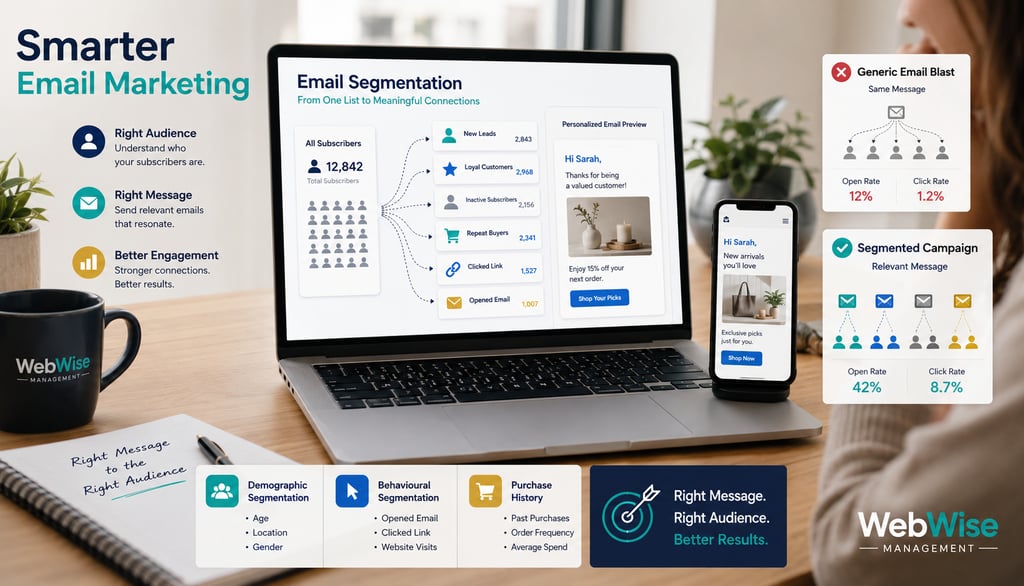
Segmentation means dividing your email list into smaller groups based on shared traits or behaviours. Personalization means tailoring the message so it feels relevant to the person receiving it. Together, they turn generic email blasts into useful, targeted communication.
The data is persuasive. HubSpot’s marketing statistics report that segmented emails drive 30% more opens and 50% more clickthroughs than unsegmented ones. It also states that 78% of marketers say subscriber segmentation is their most effective email marketing strategy, while 93% of marketers report that personalization improves leads or purchases.
For small businesses, that means better results do not always require a bigger list. Sometimes, they require smarter messaging.
The Problem With Generic Email Blasts
A generic email blast treats every subscriber as if they have the same needs, history and level of interest.
Imagine a local salon sends one email to its full list:
“Book your appointment this month.”
That message may be relevant to some people, but not all. A customer who recently had a treatment may need aftercare tips. A new subscriber may need an introduction to services. A regular client may respond better to loyalty offers. Someone who has not booked in a year may need a reactivation message.
The same applies to service businesses, retailers, consultants and local professionals.
A mechanic could send different emails to customers who recently serviced their cars, people due for tyre checks and customers who requested quotes but never booked. A web design agency could separate new leads, current maintenance clients and past redesign customers. A retailer could send different recommendations to people who bought children’s products, homeware or seasonal gifts.
Relevance is what makes people open, click and act.
Segmenting by Demographic, Behaviour and Purchase History
Segmentation can sound technical, but small businesses can start simply. You do not need dozens of complex customer groups on day one. Begin with segments that naturally match your business.
Demographic Segmentation
Demographic segmentation groups people by basic characteristics such as location, age range, customer type or business type.
Examples include:
Customers in a specific town or suburb.
Residential clients vs commercial clients.
New parents, students, retirees or professionals.
Local customers vs online customers.
Small-business owners vs corporate contacts.
For example, a travel agent might send family holiday packages to parents and honeymoon offers to engaged couples. A local service provider might send storm preparation tips only to customers in affected areas.
Behavioural Segmentation
Behavioural segmentation is based on what people do.
This might include:
People who opened recent emails.
People who clicked a specific service link.
People who downloaded a guide.
People who visited a landing page.
People who abandoned a cart.
People who enquired but did not book.
People who have not engaged for six months.
Behavioural segmentation is powerful because it is based on interest. If someone clicked a link about website redesigns, they may be more interested in a redesign checklist than a general newsletter.
Purchase History Segmentation
Purchase history helps you send better follow-ups and recommendations.
Examples include:
First-time buyers.
Repeat customers.
High-value customers.
Customers who bought a specific product.
Customers due for renewal, service or replacement.
Customers who have not purchased in a long time.
An e-commerce store can recommend related products. A salon can send aftercare advice after a colour appointment. A mechanic can remind customers about service intervals. A consultant can follow up with helpful resources after a workshop.
The goal is not to be intrusive. The goal is to be helpful at the right time.
Crafting Personalized Subject Lines and Content
Personalization is often misunderstood. It is not only adding “Hi Sarah” at the start of an email. That can help, but true personalization goes deeper.
A personalized email reflects the subscriber’s interests, needs or previous actions.
Compare these subject lines:
“March Newsletter”
versus:
“Still thinking about refreshing your website?”
The second subject line speaks to a specific problem. It feels more relevant.
Here are examples of stronger personalized subject lines:
“Your next tyre check could prevent bigger problems”
“A quick reminder before your next colour appointment”
“Is your Google Business Profile costing you enquiries?”
“Still need help with your website redesign?”
“New arrivals based on your last purchase”
“A special thank-you for our regular clients”
Personalized content should also match the segment. For example, a website agency could send:
To new leads:
“Here are five signs your current website may be losing enquiries.”
To existing clients:
“Here is what we updated on your website this month and what we recommend next.”
To inactive contacts:
“Still need help improving your online presence? Here are three small updates that can make a big difference.”
HubSpot also reports that 53% of marketers use basic personalization, such as including a name in email copy, while 26% say email marketing is one of the most effective channels for segmentation and personalization. The opportunity for small businesses is to move beyond the basics and make the whole message more relevant.
Tools and Automation to Make It Easier
Segmentation and personalization do not need to be managed manually forever. Most modern email platforms include list groups, tags, automated workflows and performance reporting.
Common types of automation include:
Welcome sequences
These introduce new subscribers to your business, explain what you offer and guide them toward a first enquiry or purchase.
Abandoned cart emails
Useful for e-commerce stores, these remind customers to complete purchases they started.
Reactivation campaigns
These target people who have not opened, clicked or purchased recently.
Post-purchase follow-ups
These provide aftercare tips, review requests, related products or next-step service reminders.
Lead nurture sequences
These educate potential customers over time until they are ready to buy.
HubSpot’s 2026 marketing data shows that 47% of marketers use automation to make marketing processes more efficient, while 93% report using automation for administrative tasks and 92% use it for data analysis and reporting. For small businesses, automation is valuable because it saves time while keeping communication consistent.
The key is to avoid over-automating without strategy. A badly timed automated email can feel cold. A well-planned email sequence feels helpful and timely.
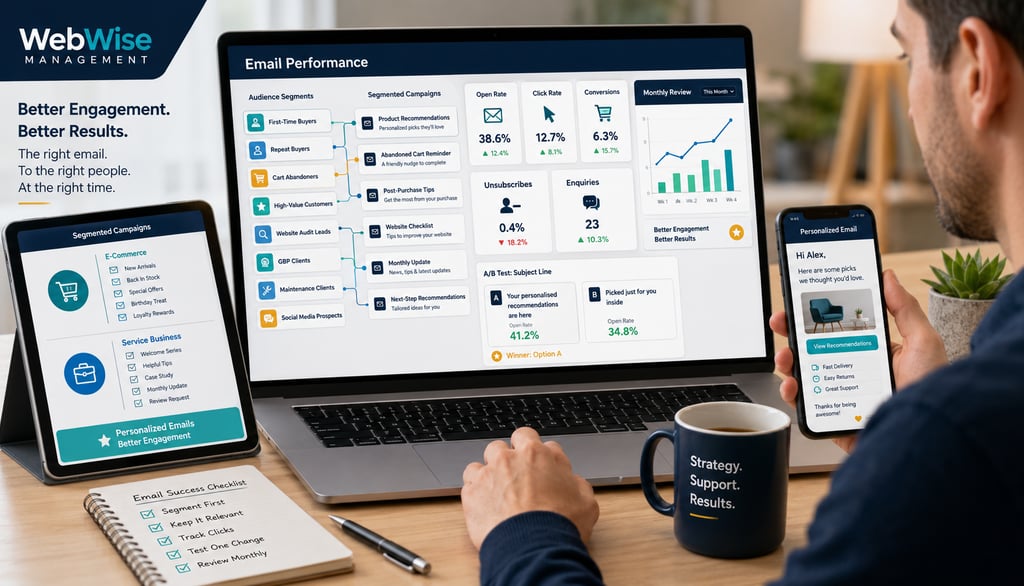
Practical Email Segmentation Examples
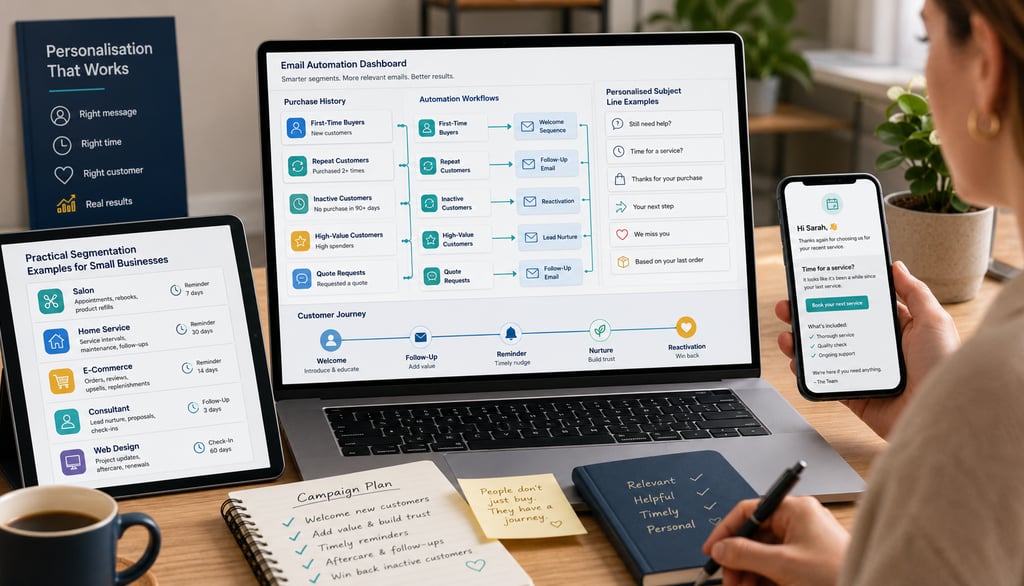
Here are a few simple examples small businesses can use.
Local Salon
Segments:
New subscribers.
Regular clients.
Colour treatment clients.
Inactive clients.
Bridal enquiries.
Campaign ideas:
Welcome email with popular services.
Colour aftercare tips after appointments.
Loyalty reward for repeat clients.
“We miss you” rebooking campaign.
Bridal hair preparation checklist.
Home Service Business
Segments:
Emergency enquiries.
Past repair customers.
Maintenance plan customers.
Customers in specific suburbs.
Quote requests not yet converted.
Campaign ideas:
Seasonal maintenance reminders.
Follow-up after quote.
Review request after completed work.
Area-specific storm preparation tips.
Maintenance plan offer.
E-Commerce Store
Segments:
First-time buyers.
Repeat buyers.
Cart abandoners.
Product category interests.
High-value customers.
Campaign ideas:
Product recommendations.
Reorder reminders.
Exclusive early access.
Abandoned cart recovery.
Post-purchase care instructions.
WebWise-Style Service Business
Segments:
Website audit leads.
Blog writing enquiries.
Google Business Profile clients.
Social media management prospects.
Existing maintenance clients.
Campaign ideas:
Website conversion checklist.
Monthly GBP update reminder.
Blog topic ideas for small businesses.
Social media content planning tips.
Maintenance report and next-step recommendations.
These examples show why personalized email campaigns work: the reader receives something that matches their situation.
Measuring Success: Opens, Clicks and Conversions
Email marketing should be measured, but not every metric has equal value.
Mailchimp’s benchmark data shows average email performance varies by industry. For example, its all-user benchmark lists an average open rate of 35.63%, an average click rate of 2.62% and an unsubscribe rate of 0.22%, while categories such as e-commerce, education and nonprofits differ. These benchmarks can help you compare performance, but your own historical results matter most.
Track these core metrics:
Open rate
Shows how many people opened the email. Useful for subject line testing, but not perfect because privacy features can affect accuracy.
Click-through rate
Shows how many people clicked links. This is often more meaningful because it reflects active interest.
Conversion rate
Shows how many people completed the desired action, such as booking, buying, requesting a quote or filling in a form.
Unsubscribe rate
Shows whether your content is losing relevance or being sent too often.
Revenue or enquiries generated
For small businesses, this is the clearest business outcome.
To improve results, test one thing at a time: subject line, send time, offer, email layout, CTA or audience segment. Small improvements compound over time.
Email Marketing Tips for Small Business
Use these practical email marketing tips for small business campaigns:
Start with a clean, permission-based list.
Segment your list before sending promotions.
Personalize based on behaviour, not just first name.
Keep emails focused on one main action.
Use clear subject lines.
Make emails mobile-friendly.
Include visible buttons.
Send useful content, not only sales messages.
Remove inactive or invalid contacts regularly.
Track clicks and conversions, not only opens.
Use automation for welcome, follow-up and reactivation campaigns.
Review results monthly and adjust.
The best email marketing feels like service, not interruption.
How WebWise Management Can Help
Many small-business owners already know email marketing matters, but they struggle to set it up properly. Lists become messy. Campaigns are inconsistent. Messages are generic. Results are not tracked clearly.
WebWise Management can help create a smarter email marketing system by supporting:
Email list setup and clean-up.
Audience segmentation.
Campaign planning.
Email copywriting.
Personalized subject lines.
Automated welcome and follow-up sequences.
Blog-to-email repurposing.
Newsletter design.
Performance reporting.
Ongoing campaign management.
The goal is not to send more emails for the sake of it. The goal is to send better emails to the right people at the right time.
Final Thoughts
Email marketing works best when it feels relevant. Generic blasts may reach inboxes, but targeted emails are more likely to earn attention, clicks and conversions.
Segmentation helps you understand who you are speaking to. Personalization helps you say something that matters to them. Together, they can improve open rates, click-throughs, leads and purchases.
For small businesses, this is a major opportunity. You do not need a massive list or complicated system to begin. Start with a few useful segments, send helpful messages and measure what happens.
Need help turning your email list into a stronger marketing asset? Contact WebWise Management for segmented email marketing, personalized campaigns and practical automation that helps your business improve engagement and generate more enquiries.
Contact
Reach out anytime for personalized support.
Email:
Phone:
+27 72 709 7557
© 2026. All rights reserved.