
Content Calendar & Strategy: How Documentation Drives Better ROI
Learn how a documented content strategy and calendar help small businesses plan, publish and grow.
WebWise Management
7/6/20267 min read
Plan Your Content Like a Pro: Creating a Calendar and Documented Strategy for Long-Term Success
Content marketing often starts with good intentions. You plan to post regularly, write blogs, send emails, share updates on social media and keep your audience engaged. Then business gets busy. A client needs attention. Staff are off sick. A quote needs chasing. Before long, marketing becomes something you do when you remember, not something that steadily builds your brand.
That is where a documented content strategy and calendar make the difference.
For small-business owners and entrepreneurs, content planning is not about making marketing more complicated. It is about making it more sustainable. A clear plan helps you know what to publish, when to publish it, who it is for and how each piece supports your business goals.
Research from Content Marketing Institute and MarketingProfs found that only 40% of B2B marketers had a documented content marketing strategy, while 64% of the most successful marketers had one. The same report warned that without a strategy, too many marketers create content for the sake of creating content or simply respond to ad hoc requests.
In other words, successful content is rarely random. It is planned, documented, measured and improved over time.
What is a content calendar and why you need one
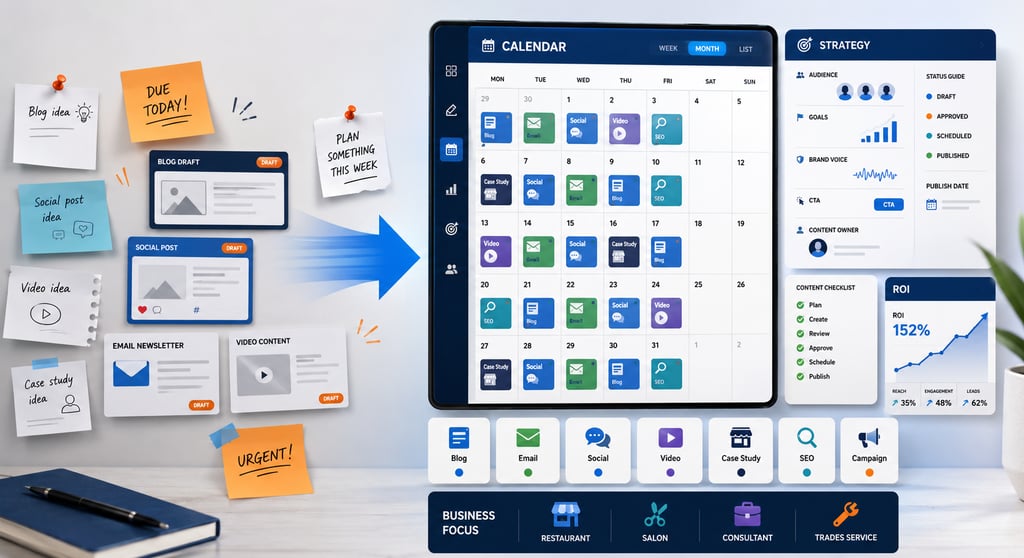
A content calendar for small business is a schedule that shows what content you will create, where it will be published and when it will go live. It might include blogs, email newsletters, social media posts, videos, case studies, promotions, seasonal campaigns and customer education content.
Think of it as your marketing roadmap. Instead of waking up on Monday and thinking, “What should we post today?”, your calendar already gives you direction.
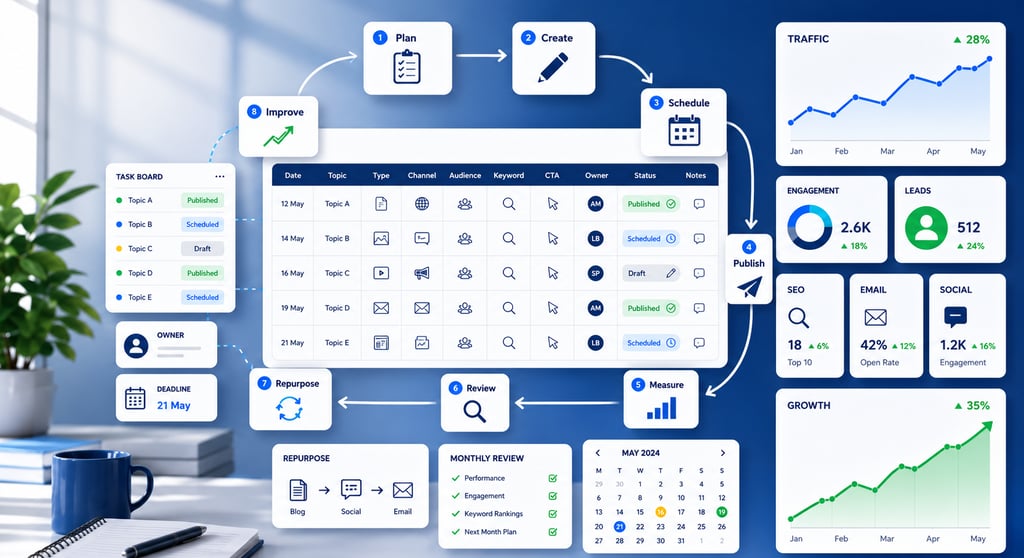
A useful content calendar usually includes:
publication date;
content topic;
target audience;
format, such as blog, email, reel, guide or case study;
channel, such as website, LinkedIn, Instagram, Facebook or email;
keyword or SEO focus;
owner or person responsible;
status, such as idea, draft, approved, scheduled or published;
call to action.
For a small business, this simple structure can remove a lot of stress. A restaurant can plan seasonal menu posts before key holidays. A salon can schedule haircare tips around wedding season. A consultant can map blogs to common client questions. A trades business can prepare winter maintenance advice before customers urgently need it.
The result is marketing that feels organised rather than rushed.
Benefits of documenting your content strategy
A content calendar tells you what is happening. A documented content strategy explains why it is happening.
Your strategy should define your goals, audience, messaging, content themes, channels, publishing rhythm and measurement approach. Without it, a calendar can quickly become a list of disconnected posts.
Content Marketing Institute’s 2025 research found that only 29% of marketers with a documented strategy rated it extremely or very effective. Among those whose strategies were less effective, 42% pointed to a lack of clear goals, 39% said the strategy was not tied to the customer journey, and 35% said it was not data driven.
That is an important lesson: documentation alone is not magic. The strategy has to be useful, specific and connected to business outcomes.
When done well, documentation helps you:
Stay consistent. You are not relying on last-minute inspiration. You have a repeatable system.
Protect your brand voice. Everyone creating content understands your tone, message and values.
Make better decisions. You can say no to random content ideas that do not support your goals.
Improve ROI. You can track what is working, stop wasting time on weak activity and put more effort into content that generates enquiries.
Reduce pressure on the owner. Your marketing no longer lives only in your head.
For small teams, this is especially valuable. A documented plan helps staff, freelancers or agencies work from the same page.
Steps to create your own calendar
You do not need a huge strategy document to start. You need a clear, practical plan that your business can actually follow.
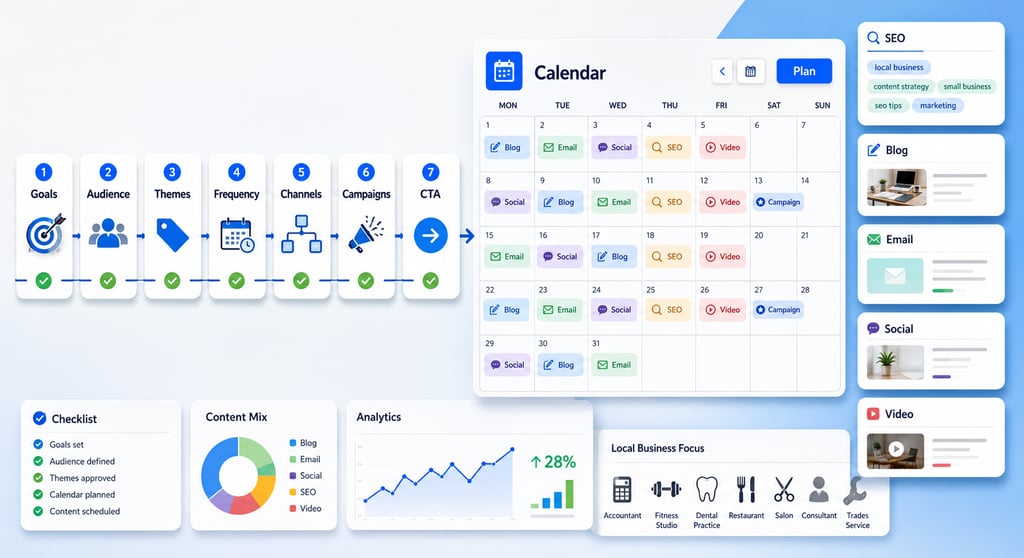
1. Define your business goals
Start with what you want content to achieve. Do not begin with platforms or post ideas. Begin with outcomes.
Your goals might include:
increasing website enquiries;
improving local search visibility;
educating potential customers;
building trust before a sales call;
promoting a new service;
increasing repeat bookings;
growing your email list;
reducing common customer questions.
For example, a local accountant might set a goal to generate more tax-planning enquiries from small-business owners. A fitness studio might want more trial class bookings. A dental practice might want to build trust around cosmetic treatments.
Once the goal is clear, content becomes easier to plan.
2. Understand your audience
Your content should answer the questions your customers are already asking.
Ask yourself:
What problems do customers come to us with?
What do they misunderstand before buying?
What objections stop them from enquiring?
What seasonal needs affect them?
What advice would build trust before they contact us?
A trades business might find that customers worry about price, reliability and mess. A consultant might need to explain process and outcomes. A restaurant might focus on atmosphere, dietary options and events.
Good content planning starts with customer insight, not guesswork.
3. Choose your content themes
Content themes are the recurring topics your business wants to be known for. They keep your marketing focused.
A beauty salon might use themes such as:
haircare education;
treatment benefits;
client transformations;
seasonal style inspiration;
team expertise.
A business consultant might use:
growth strategy;
productivity;
leadership;
case studies;
common business mistakes.
Choose three to five core themes. These become the backbone of your calendar.
4. Decide your publishing frequency
Consistency matters more than unrealistic ambition.
It is better to publish one useful blog per month and three strong social posts per week than to plan daily content and stop after two weeks.
Set a rhythm your team can maintain. For many small businesses, a practical monthly plan might include:
one blog post;
one email newsletter;
eight to twelve social posts;
one customer story or case study;
one promotional campaign or offer.
A realistic schedule protects your energy and makes content marketing sustainable.
5. Map content to channels
Different channels serve different purposes.
Your website is ideal for evergreen content, service pages, blogs and SEO-led education. Email is useful for nurturing existing contacts. Social media helps with visibility, community and personality. Video can explain complex ideas quickly and build familiarity.
The CMI 2025 roundup found that B2B marketers commonly use short articles, videos, case studies and long articles, while organic social media, corporate blogs and email newsletters remain widely used distribution channels.
For small businesses, the lesson is not to be everywhere. It is to choose the channels your audience actually uses and plan content for each with purpose.
6. Add campaigns and seasonal moments
Your calendar should include predictable events before they arrive.
Examples include:
holidays and local events;
school terms;
tax deadlines;
wedding season;
summer promotions;
winter maintenance;
industry awareness days;
product launches;
annual reviews.
Planning ahead gives you time to create stronger content instead of rushing.
7. Include calls to action
Every piece of content should guide the reader somewhere.
That does not mean every post should be a hard sell. Calls to action can be soft, helpful and varied.
Examples include:
“Read the full guide.”
“Book a consultation.”
“Download the checklist.”
“Ask us for a quote.”
“Join our email list.”
“Send us your question.”
Your content calendar should note the intended CTA so each post has a business purpose.
Tools and templates to stay organised
A marketing calendar template does not have to be fancy. The best tool is the one your team will actually use.
Popular options include:
Google Sheets or Excel
Simple, flexible and ideal for small teams starting out.
Trello or Asana
Useful if you want to track tasks through stages such as idea, draft, review, approved and scheduled.
Notion
Good for combining strategy notes, calendars, briefs and content ideas in one place.
Google Calendar
Helpful for viewing campaign dates, deadlines and publishing schedules.
Social scheduling tools
Useful for batching posts and reducing daily admin.
Your template should include enough detail to keep work moving, but not so much that it becomes a burden.
A practical small-business content calendar might include these columns:
date;
topic;
content type;
channel;
audience;
keyword;
CTA;
owner;
status;
performance notes.
This gives you both planning visibility and a record of what happened.
Measuring and adjusting your plan
A content plan is not something you create once and forget. It should improve as you learn.
CMI’s 2025 statistics show that 56% of B2B marketers named attributing ROI to content efforts as a measurement challenge, and 56% also struggled with tracking customer journeys. The same roundup found that marketers track metrics such as traffic, engagement, conversions, leads, search rankings and subscriber growth.
For small businesses, measurement does not need to be overwhelming. Focus on the numbers that connect to your goals.
Track:
website visits to blog posts;
enquiry form submissions;
calls from website pages;
email opens and clicks;
social engagement;
search rankings;
booked consultations;
quote requests;
repeat purchases;
content-assisted sales conversations.
Review your calendar monthly. Ask:
Which topics attracted the most engagement?
Which posts led to enquiries?
Which channels performed best?
Which content took too long to create?
What questions are customers asking now?
What should we repurpose?
This is where your strategy becomes smarter. A blog that performs well can become social posts, an email, a video script and a downloadable guide. A frequently asked question can become a service-page section. A customer success story can become a case study and sales asset.
Planning does not limit creativity. It gives creativity a structure.
Quick content planning checklist
Use this checklist before building your next month of content:
Have we chosen one to three clear business goals?
Do we know which audience we are speaking to?
Have we selected our main monthly themes?
Have we planned content for each priority channel?
Have we included SEO keywords where relevant?
Have we added seasonal or promotional opportunities?
Does every piece have a call to action?
Has someone been assigned responsibility?
Are deadlines realistic?
Have we scheduled a review of results?
If you can answer yes to these questions, you are already ahead of many businesses still relying on last-minute marketing.
Build a content system that supports long-term growth
Ad hoc marketing might keep your pages active, but it rarely builds momentum. A documented content strategy and calendar help your business show up consistently, communicate clearly and turn content into a long-term growth asset.
For small-business owners, the goal is not to create more noise. It is to create the right content, for the right people, at the right time.
WebWise Management helps businesses build practical content strategies, create marketing calendars, plan SEO-led topics and maintain consistent publishing schedules. Whether you need a one-off content planning session, a reusable calendar template or ongoing content support, our team can help you turn scattered ideas into an organised marketing system.
Ready to plan your content like a pro? Contact WebWise Management to build a documented content strategy and content calendar that supports your long-term growth.
Contact
Reach out anytime for personalized support.
Email:
Phone:
+27 72 709 7557
© 2026. All rights reserved.