
Blogging for ROI: How Small Businesses Can Drive Leads and Sales
Discover how consistent blogging can boost traffic, leads and authority, and why small businesses should invest in content.
WebWise Management
6/14/20267 min read


Blogging for ROI: Why Small Businesses Can’t Afford to Skip Content Marketing
Blogging as a Marketing Powerhouse
Many small-business owners understand the value of having a website, social media pages and a Google Business Profile. But blogging is often treated as optional — something to do “when there is time.”
The problem is that time rarely appears.
Customer work, admin, stock, staffing, quotes, invoices and daily operations usually come first. Before long, the website has not been updated in months, the blog is empty and potential customers have no fresh reason to visit, trust or enquire.
That is a missed opportunity because blogging is one of the most practical long-term marketing tools available to small businesses.
A blog gives your website more than a digital brochure. It turns it into a helpful resource that answers customer questions, supports search visibility, builds authority and creates pathways to enquiries. DemandSage’s 2026 business blogging statistics report that around 80% of businesses use blogs as a marketing tool, and that blogging can boost website traffic by 55%. The same source states that businesses focusing on blogging are 13 times more likely to see positive ROI.
For entrepreneurs, solopreneurs and local service providers, this matters. A good blog can work while you are busy serving customers. It can attract search traffic, educate prospects and give people a reason to choose your business before they ever speak to you.
How Blogging Increases Website Traffic
Search engines need content to understand what your business does. A five-page website can explain your main services, but it has limited space to answer all the questions your customers may ask.
A blog expands that reach.
For example, a plumber’s website may have a service page for “geyser repairs.” But a blog can target related questions such as:
“Why is my geyser leaking?”
“How do I know if my geyser needs replacing?”
“What causes low hot water pressure?”
“Should I repair or replace my geyser?”
Each blog post creates another useful entry point to the website. Instead of relying only on people searching for your exact service, you can reach customers earlier in their decision-making process.
This is one of the key benefits of business blogging. It allows you to meet customers when they are researching, comparing and trying to understand their problem. By the time they are ready to enquire, your business already feels helpful.
HubSpot has long reported that businesses with blogs attract more website visitors, and its lead-generation analysis found that customers with blogs gathered 68% more leads than those without blogs. It also noted that blog growth becomes more meaningful once a website has more than 20 articles available.
That does not mean you need to publish 20 articles immediately. It means blogging compounds. One article may help a little. Ten articles help more. A consistent library of helpful content can become a long-term traffic asset.
Outsourcing vs. Doing It Yourself
Some business owners can write their own blogs. They know their customers, services and industry well. If they have time, writing skill and a clear strategy, DIY blogging can work.
But many small-business owners struggle with consistency. They know what they want to say but do not know how to structure it, optimize it, title it or turn it into a lead-generation asset.
That is where outsourcing helps.
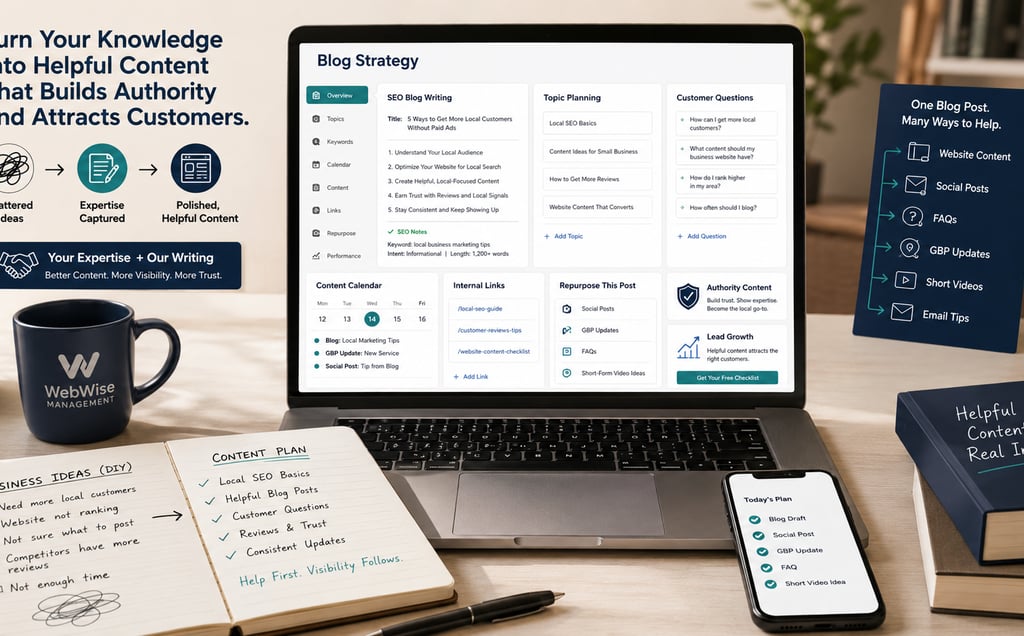
A professional blog writing service can support:
Topic planning.
Keyword research.
SEO-friendly structure.
Clear, persuasive copywriting.
Internal linking.
Calls-to-action.
Fact-checking.
Editing.
Publishing schedules.
Repurposing for social media and Google Business Profile posts.
Outsourcing does not remove your expertise. It turns your expertise into polished content that customers can find, understand and act on.
The best blog content still needs your business insight. A professional writer can interview you, review your services, research customer questions and create content that sounds credible without requiring you to spend hours drafting each post.
How Blogging Builds Authority
A blog gives small businesses a way to demonstrate expertise before the sales conversation.
Think about the difference between two businesses.
Business A has a website with a homepage, services page and contact form.
Business B has the same pages, plus helpful articles answering customer questions, explaining services, sharing examples and offering practical advice.
Which business feels more knowledgeable?
Authority is built through repeated usefulness. When your website consistently answers real customer questions, visitors begin to trust your perspective. This is especially valuable in industries where customers need reassurance: home services, finance, health and wellness, consulting, automotive, travel, property and professional services.
A blog also supports your wider sales process. You can send prospects relevant articles after calls. You can link to posts in quotes. You can share blogs on social media. You can use blog sections as FAQs. You can repurpose articles into short videos and email newsletters.
That is why blogging ROI is not only measured in direct form submissions from one article. Content can assist the whole customer journey.
Getting Started with WebWise’s Blogging Service
Starting a blog does not need to be overwhelming. The best approach is to begin with customer questions and business goals.
Ask:
What services do we want to promote?
What questions do customers ask before buying?
What objections stop people from enquiring?
What local searches matter to our business?
Which pages need more supporting content?
What proof, stories or examples can we share?
From there, build a simple content plan.
For example, WebWise Management might help a service business create a three-month blog plan covering website improvements, Google Business Profile optimization, review management, local SEO and social media content. Each post would be written to educate readers, support search visibility and guide visitors toward an enquiry.
WebWise can also help distribute the content. One blog post can become social media captions, Google Business Profile updates, email content, FAQs and short-form video scripts. That makes blogging more efficient and gives your business more visibility from one strong idea.
Final Thoughts
Small businesses cannot afford to skip content marketing because customers are already searching for answers. They want to understand problems, compare options and trust the businesses they choose.
Blogging helps your business appear in those moments. It can increase website traffic, support SEO, generate leads, build authority and create content that can be reused across multiple channels.
The data is persuasive: many businesses use blogs as a marketing tool, blogging can increase traffic, companies with blogs generate more leads and businesses that prioritize blogging are far more likely to see positive ROI.
The real question is not whether blogging can work. It is whether your business is willing to publish consistently and strategically.
Need help turning your expertise into content that attracts and converts customers? Contact WebWise Management for professional blog writing and distribution services that help your business build visibility, authority and long-term lead growth.


Lead Generation and ROI Statistics
Traffic is useful, but leads matter more. A blog should not only attract readers; it should help convert the right readers into enquiries.
HubSpot’s research into 2,300 customers found that businesses that blog experienced 126% higher monthly lead growth than businesses that did not blog. In the study, blogging businesses saw 165% lead growth compared with 73% for non-blogging businesses.
DemandSage’s 2026 roundup also reports that small businesses that blog experience 126% more lead growth and that B2B businesses with blogs generate 67% more leads. HubSpot’s blogging statistics page similarly cites DemandMetric’s figure that companies with blogs produce an average of 67% more leads monthly than companies without blogs.
These numbers make the case for blog lead generation. Blogging works because it builds a bridge between customer questions and business services.
A local electrician can write about warning signs of faulty wiring and link readers to an inspection service. A salon can write about preparing for a colour appointment and link to online bookings. A consultant can write about common business growth mistakes and invite readers to schedule a strategy session.
The blog educates first. Then it guides the reader toward the next step.
Content Types That Perform
Not every blog post needs to be the same. A strong content marketing for small business strategy usually includes several types of posts.
How-To Guides
How-to posts are excellent for search because people often look for practical instructions.
Examples:
“How to Prepare Your Home for a Roof Inspection”
“How to Choose the Right Website Package”
“How to Get More Google Reviews Without Sounding Pushy”
These posts build trust because they show you understand the process.
Problem-Solving Posts
These posts target customers who are experiencing a specific issue.
Examples:
“Why Your Website Is Getting Visitors but No Leads”
“Why Your Car Pulls to One Side”
“Why Your Air Conditioner Is Leaking Water”
Problem-solving posts often attract high-intent visitors because the reader already has a need.
Comparison Posts
Comparison posts help customers make decisions.
Examples:
“Website Redesign vs Website Refresh: Which Do You Need?”
“DIY Website vs Professional Web Design”
“Google Ads vs Local SEO for Small Businesses”
These are useful because customers often compare options before spending money.
Case Studies and Customer Stories
Case studies show proof. They explain a problem, the solution and the result. They are especially useful for consultants, agencies, contractors, property services and B2B businesses.
A case study could show how a business improved its website, increased enquiries or simplified its customer booking process. The important thing is to be specific and honest.
Local Content
Local service providers can benefit from posts connected to their area.
Examples:
“Common Plumbing Problems in Coastal Homes”
“Website Tips for Small Businesses in Durban”
“Preparing Your Property for the Rainy Season in Gauteng”
Local content supports search visibility and makes the business feel relevant to nearby customers.
How Often Should You Post?
Consistency matters more than perfection. Many small businesses start blogging with big intentions and then stop after two posts because the schedule is unrealistic.
A useful starting point is one to four blog posts per month.
One strong post per month is better than publishing weekly for a month and then disappearing for the rest of the year. Two posts per month can build steady momentum. Four posts per month can work well for businesses investing seriously in SEO and content growth.
HubSpot’s 2026 marketing statistics show that blog posts remain among the top five highest-ROI content formats according to marketers, and blog posts are also among the top five content formats marketers plan to invest in for 2026. That does not mean every business needs a huge publishing team. It means consistent, useful written content remains part of a serious marketing strategy.
A practical monthly schedule could look like this:
Week 1: Educational how-to post.
Week 2: Service-focused post.
Week 3: Customer question or FAQ post.
Week 4: Case study, local topic or comparison post.
Each blog can then be repurposed into social media captions, Google Business Profile posts, email snippets and short-form video ideas. This gives you more value from every article.
Contact
Reach out anytime for personalized support.
Email:
Phone:
+27 72 709 7557
© 2026. All rights reserved.